SuedLink Power Line Reaches Construction Milestone with Completion of First Underground Cable Section
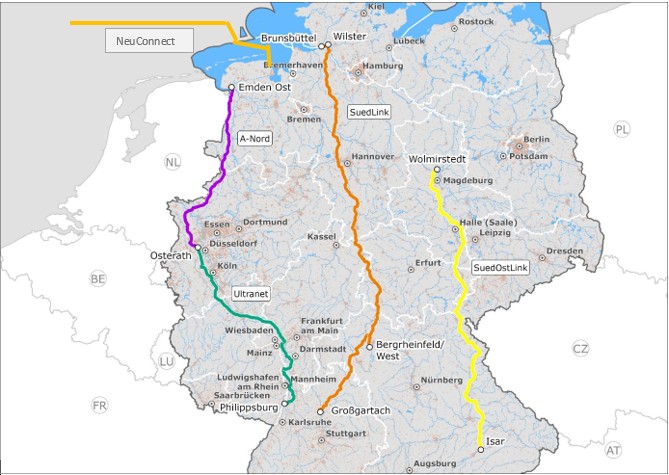
Scheeßel, Lower Saxony — The expansion of Germany's major transmission grid is progressing further, with attention currently focused on the north-south direct current links Ultranet (commissioning planned for 2026), A-Nord (2027), and SuedLink and SuedOstLink (both 2028). SuedLink, one of the central projects of Germany's energy transition, has now reached a further important construction milestone.
SuedLink: A 700-Kilometer North-South Power Corridor
The newly completed section in the Rotenburg (Wümme) district is part of the roughly 700-kilometer SuedLink direct current link. Civil engineering work on the section began in spring 2024 in the Zeven municipal association area. During construction, particular attention was paid to soil protection and the responsible handling of agricultural land. The land used is to be returned to its owners in stages.
From the end of 2028, SuedLink is intended to transport wind power from northern Germany to consumption centers in the south, contributing to security of supply, grid stability, and the competitiveness of Germany as a business location.
The project has a transmission capacity of around 4,000 MW (4 GW) and is regarded as one of the central infrastructure projects of the energy transition.
Politicians and Regional Representatives Closely Involved
Representatives from politics, local government, and agriculture attended the completion, including Lower Saxony's Energy Minister Christian Meyer and Rotenburg (Wümme) district administrator Marco Prietz.
"With the first underground cable section now complete, SuedLink is visibly becoming a reality," said Ina Kamps, COO of TenneT Germany. She said SuedLink would in future bring renewable energy to where it is needed, thereby strengthening security of supply, grid stability, and competitiveness.
Energy Minister Christian Meyer pointed to the line's significance for falling electricity costs and the integration of renewable energy. He said SuedLink was a core component of a climate-neutral energy system and would help reduce fossil-fuel reserve power plants and redispatch measures.
District administrator Marco Prietz highlighted the regional execution of the project in particular. He said construction had taken agricultural land into account while also delivering economic benefits for the region.
About the Major Power Lines Ultranet, A-Nord, SuedLink, and SuedOstLink
The major north-south direct current links trace their fundamental grid planning back to the 2012 Grid Development Plan (NEP) and subsequent expansion plans. They were developed as central transport corridors for renewable electricity from northern and eastern Germany to consumption centers in the south and west following the 2011 decision to phase out nuclear power.
The Grid Development Plan first systematically identified the need for high-capacity HVDC links. Originally, a considerably earlier realization was envisaged as part of the restructuring of the energy system and the nuclear phase-out. However, implementation was subsequently delayed significantly.
A key factor affecting project development was the underground cable priority for new direct current lines, enshrined in law in 2015. As a result, numerous projects had to be replanned and technically converted from overhead to underground cable routes, in addition to extensive permitting, public participation, and legal proceedings.
As a result, the following power line projects are today among the largest infrastructure projects of the energy transition: the Ultranet line (around 2 GW) uses existing routes and is currently scheduled to enter operation by 2026.
A-Nord (around 2 GW) is scheduled for 2027. SuedLink (around 4 GW, approximately 700 km) is to follow by the end of 2028. SuedOstLink (around 2 GW) is also planned for 2028.
Source: IWR Online, 03 Jul 2026