SuedLink: Elbe Tunnel Completed – Germany's Major Power Highways Approach 2027/28 Commissioning
Wischhafen — The expansion of Germany's major power highways for transporting wind power from northern Germany to consumption centers in the south is entering a decisive phase. At SuedLink, one of the technically most demanding construction sections has now been completed with the finishing of the 5.2-kilometer Elbe tunnel.
SuedLink Power Line: 5.2-Kilometer Tunnel Under the Elbe Completed
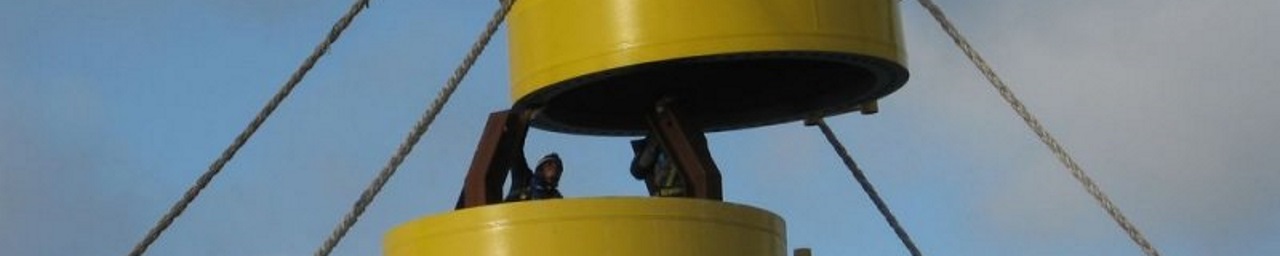
Transmission system operator Tennet Germany has completed the tunnel drive for the SuedLink Elbe crossing. The roughly 5.2-kilometer tunnel, ElbX, runs from Wewelsfleth in Schleswig-Holstein to Wischhafen in Lower Saxony, connecting the SuedLink construction sections in both states.
The roughly 200-meter tunnel boring machine, built specifically for SuedLink, began operations in Wewelsfleth in February 2025 and reached the target shaft in Wischhafen in June 2026. Following the recovery and dismantling of the machine, the tunnel is now being prepared for the subsequent cable pull.
"With ElbX, we have created a crucial building block for the realization of SuedLink, one of the most significant projects of the energy transition in Germany," said Ina Kamps, COO of Tennet Germany. SuedLink will in future primarily transport large volumes of wind energy from the north to consumption centers in the south, she said.
A total of six cables will be installed in the tunnel: two cables each for the two SuedLink systems, plus one spare cable each. The roughly 700-kilometer link is being realized by Tennet Germany and TransnetBW. SuedLink has a total transmission capacity of 4 GW and is scheduled to enter operation at the end of 2028.
Major North-South Power Lines Approach Commissioning
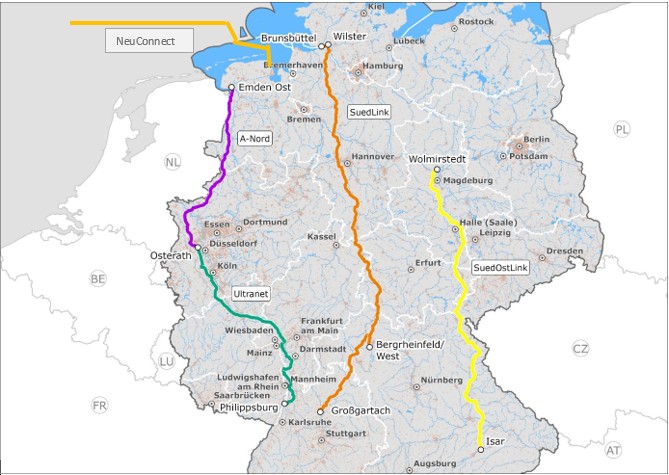
Following years of planning, permitting and construction procedures, Germany's major north-south power links are nearing completion. Ultranet, with a transmission capacity of around 2 GW, is set to be among the first major direct-current links to enter operation, in 2026. A-Nord, also rated at 2 GW, is to follow in 2027. SuedLink, with a total of 4 GW, is scheduled to be commissioned at the end of 2028.
SuedOstLink is likewise set to initially go into operation with a transmission capacity of 2 GW. The link is designed for a total capacity of 4 GW and is to be expanded in the future by a second 2-GW system.
The new direct-current links will create substantial additional transmission capacity between the wind-rich regions of northern Germany and the major consumption centers in western and southern Germany. Grid bottlenecks are expected to be reduced going forward, along with the need for redispatch and the curtailment of renewable energy.
Germany's major north-south power lines are running around six years behind their original schedules. The new transmission capacity was originally meant to be available in time for the nuclear phase-out, legally set for the end of 2022 under the 13th Amendment to the Atomic Energy Act (13. AtGÄndG) of July 31, 2011.
A key turning point came in 2015, when the grand coalition of CDU/CSU and SPD, driven substantially by then-Bavarian State Premier Horst Seehofer (CSU), decided to prioritize underground cables for the major direct-current lines. As a result, large parts of the planning had to be redone. The switch from overhead lines to underground cables led to additional costs in the billions of euros and was a major factor in the roughly six-year delay to the grid expansion.
Source: IWR Online, 20 Aug 2026